
Ligustrum sinense Lour. · Olive family (Oleaceae) · Semi-evergreen shrub from Eurasia1
Invasive in Tennessee · TN-IPC: Established2 · Found in Anderson, Knox and Roane counties3
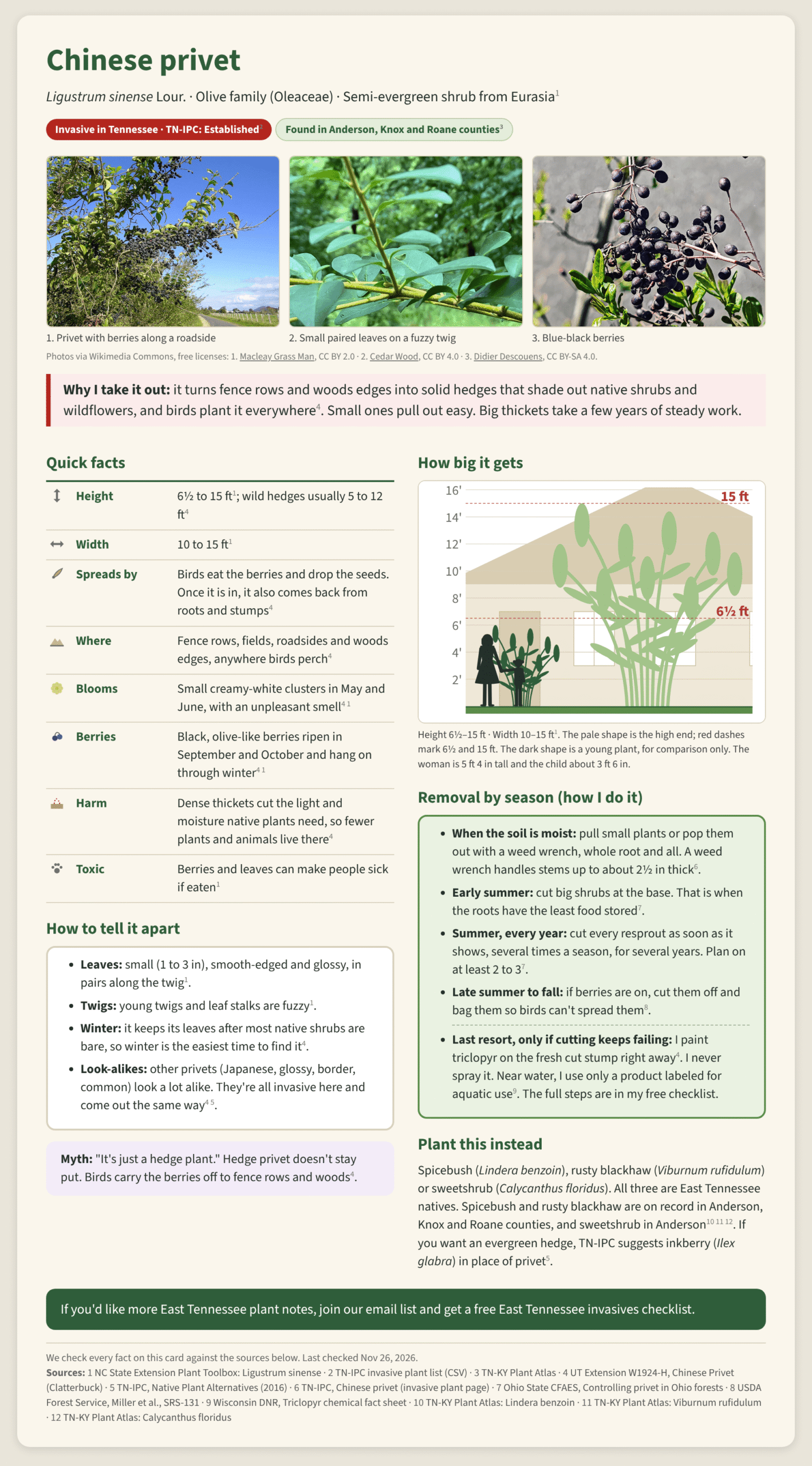



Why I take it out: it turns fence rows and woods edges into solid hedges that shade out native shrubs and wildflowers, and birds plant it everywhere4. Small ones pull out easy. Big thickets take a few years of steady work.
Quick facts
- Height: 6½ to 15 ft1; wild hedges usually 5 to 12 ft4
- Width: 10 to 15 ft1
- Spreads by: Birds eat the berries and drop the seeds. Once it is in, it also comes back from roots and stumps4
- Where: Fence rows, fields, roadsides and woods edges, anywhere birds perch4
- Blooms: Small creamy-white clusters in May and June, with an unpleasant smell4 1
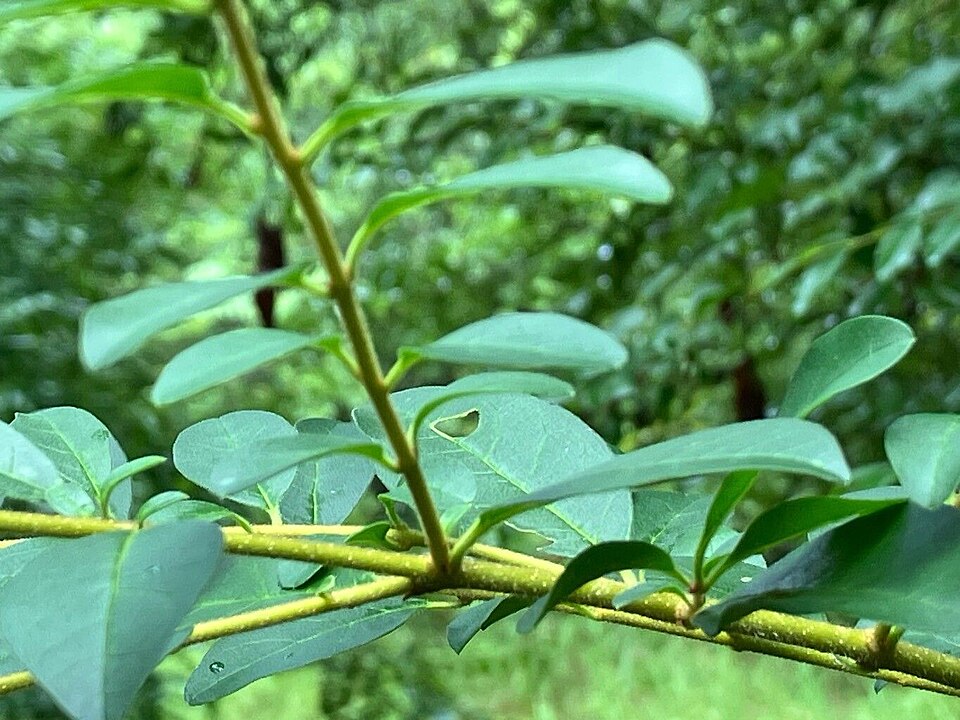
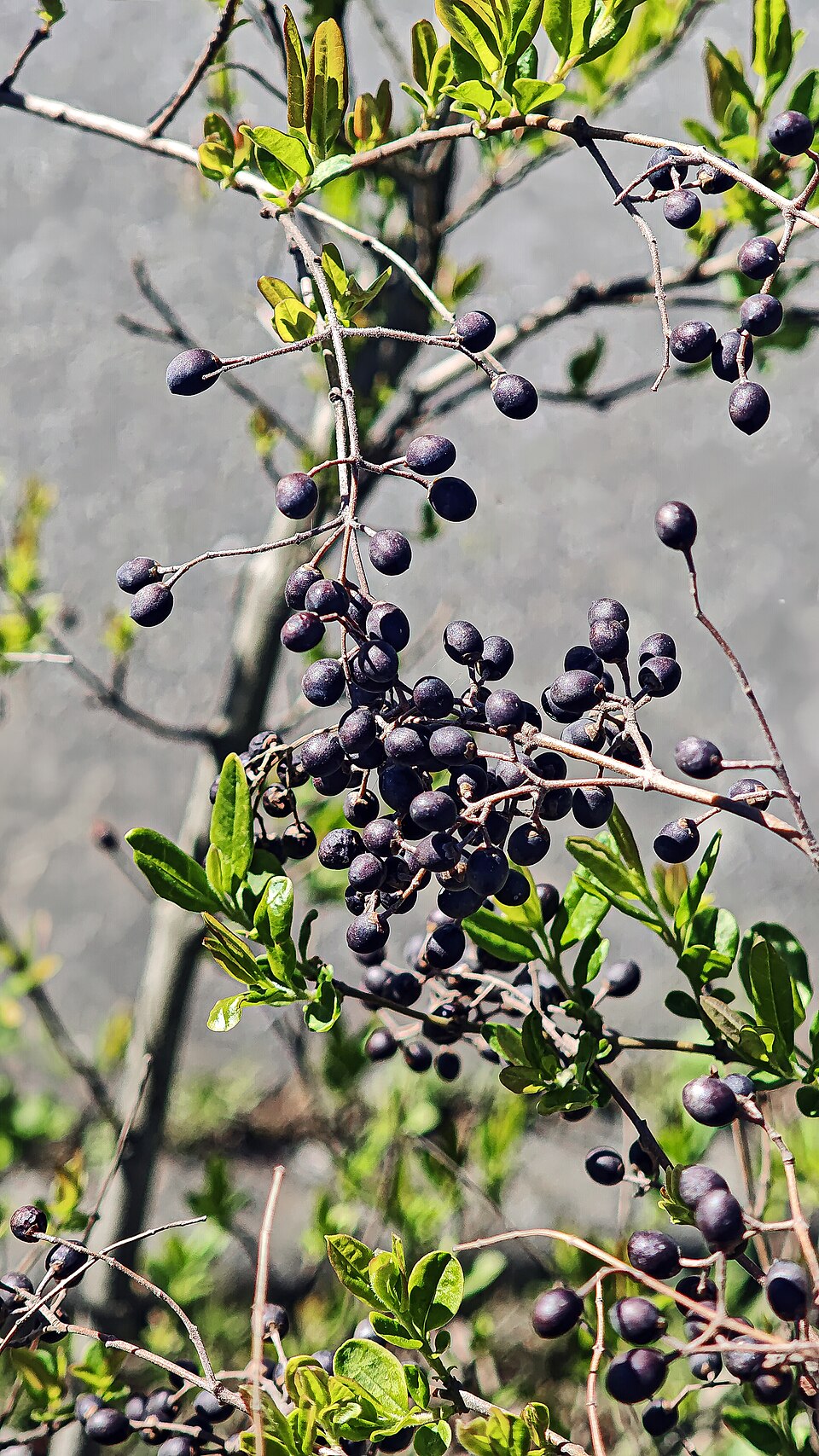
- Berries: Black, olive-like berries ripen in September and October and hang on through winter4 1
- Harm: Dense thickets cut the light and moisture native plants need, so fewer plants and animals live there4
- Toxic: Berries and leaves can make people sick if eaten1
How to tell it apart
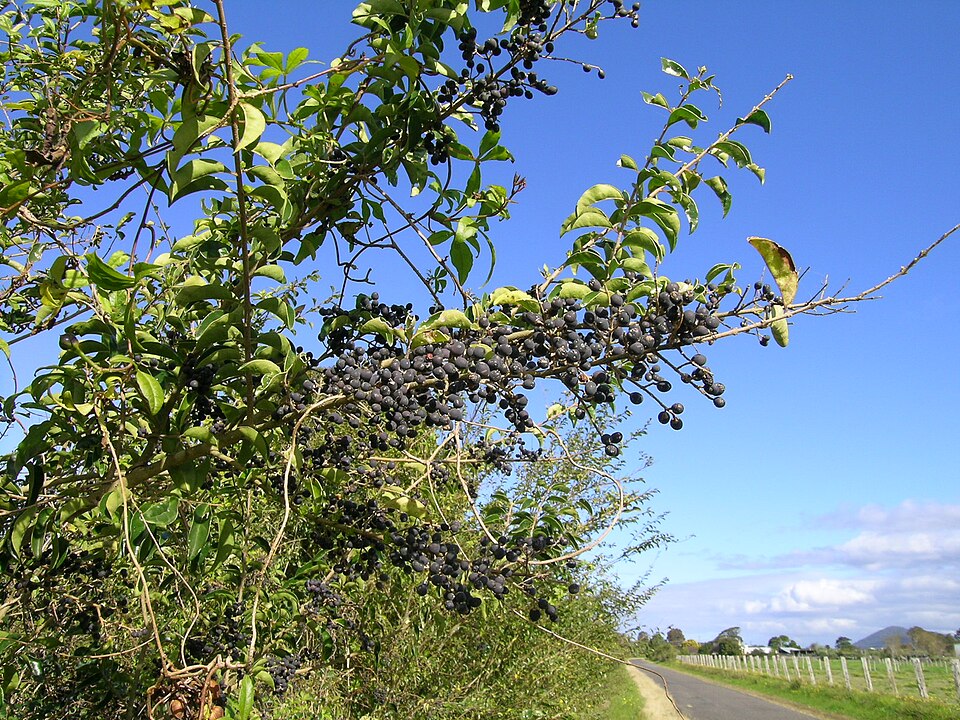
- Leaves: small (1 to 3 in), smooth-edged and glossy, in pairs along the twig1.
- Twigs: young twigs and leaf stalks are fuzzy1.
- Winter: it keeps its leaves after most native shrubs are bare, so winter is the easiest time to find it4.
- Look-alikes: other privets (Japanese, glossy, border, common) look a lot alike. They’re all invasive here and come out the same way4 5.
How big it gets
Height 6½–15 ft · Width 10–15 ft1. The pale shape is the high end; red dashes mark 6½ and 15 ft. The dark shape is a young plant, for comparison only. The woman is 5 ft 4 in tall and the child about 3 ft 6 in.
Removal by season (how I do it)
- When the soil is moist: pull small plants or pop them out with a weed wrench, whole root and all. A weed wrench handles stems up to about 2½ in thick6.
- Early summer: cut big shrubs at the base. That is when the roots have the least food stored7.
- Summer, every year: cut every resprout as soon as it shows, several times a season, for several years. Plan on at least 2 to 37.
- Late summer to fall: if berries are on, cut them off and bag them so birds can’t spread them8.
- Last resort, only if cutting keeps failing: I paint triclopyr on the fresh cut stump right away4. I never spray it. Near water, I use only a product labeled for aquatic use9. The full steps are in my free checklist.
Plant this instead
Spicebush (Lindera benzoin), rusty blackhaw (Viburnum rufidulum) or sweetshrub (Calycanthus floridus). All three are East Tennessee natives. Spicebush and rusty blackhaw are on record in Anderson, Knox and Roane counties, and sweetshrub in Anderson10 11 12. If you want an evergreen hedge, TN-IPC suggests inkberry (Ilex glabra) in place of privet5.
Myth: “It’s just a hedge plant.” Hedge privet doesn’t stay put. Birds carry the berries off to fence rows and woods4.
If you’d like more East Tennessee plant notes, join our email list and get a free East Tennessee invasives checklist.
Sources
- NC State Extension Plant Toolbox: Ligustrum sinense
- TN-IPC invasive plant list (CSV)
- TN-KY Plant Atlas
- UT Extension W1924-H, Chinese Privet (Clatterbuck)
- TN-IPC, Native Plant Alternatives (2016)
- TN-IPC, Chinese privet (invasive plant page)
- Ohio State CFAES, Controlling privet in Ohio forests
- USDA Forest Service, Miller et al., SRS-131
- Wisconsin DNR, Triclopyr chemical fact sheet
- TN-KY Plant Atlas: Lindera benzoin
- TN-KY Plant Atlas: Viburnum rufidulum
- TN-KY Plant Atlas: Calycanthus floridus
Last checked Nov 26, 2026.