
Lonicera japonica Thunb. · Honeysuckle family (Caprifoliaceae) · Semi-evergreen woody vine from eastern Asia1 2
Invasive in Tennessee · TN-IPC: Established3 · Found in Anderson, Knox and Roane counties4
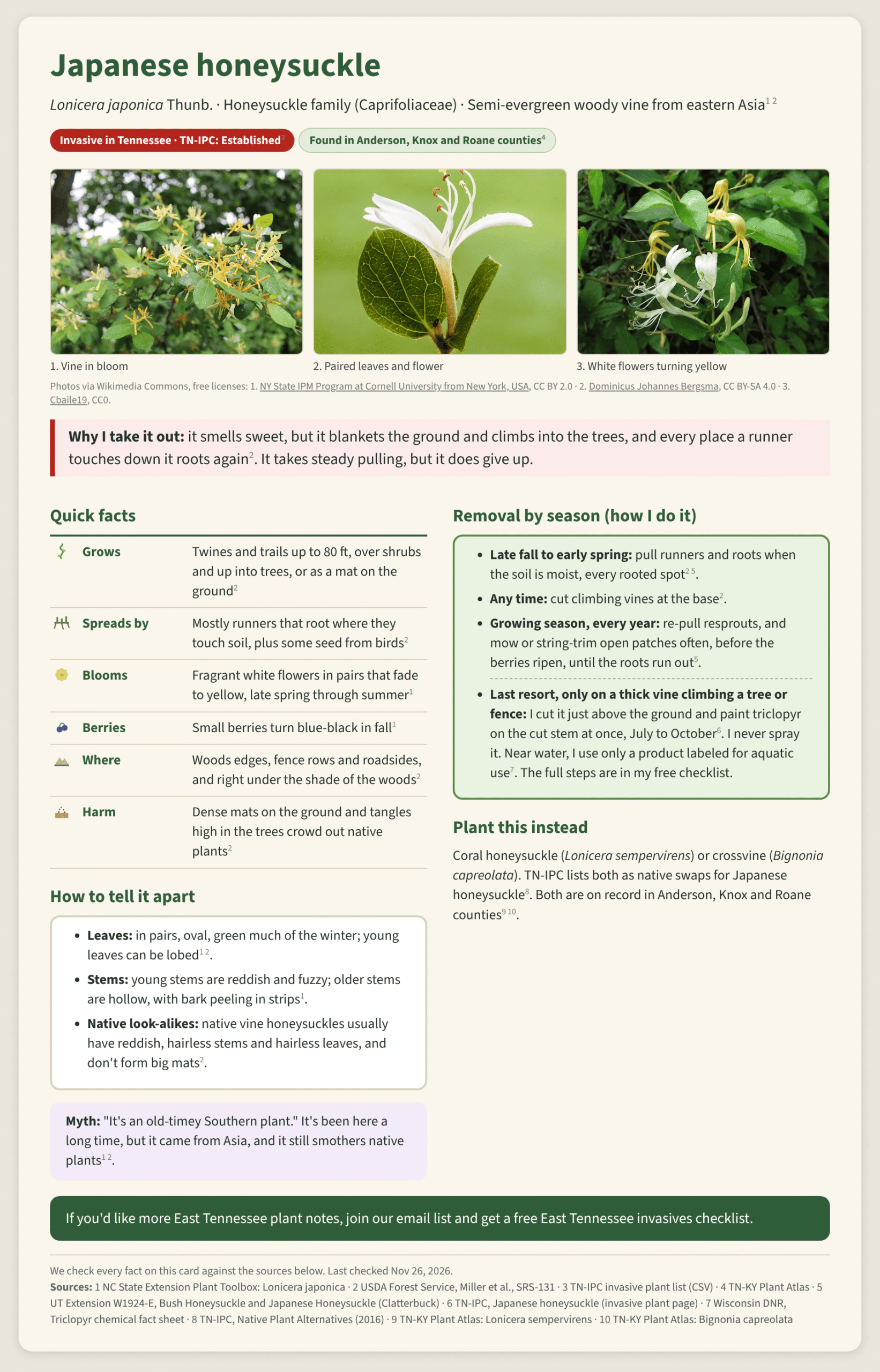
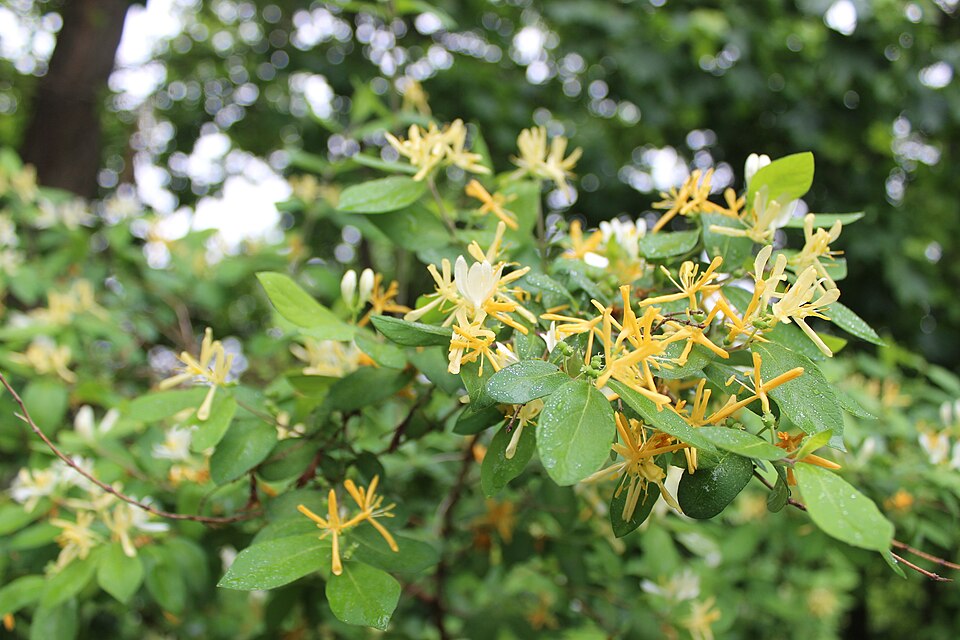

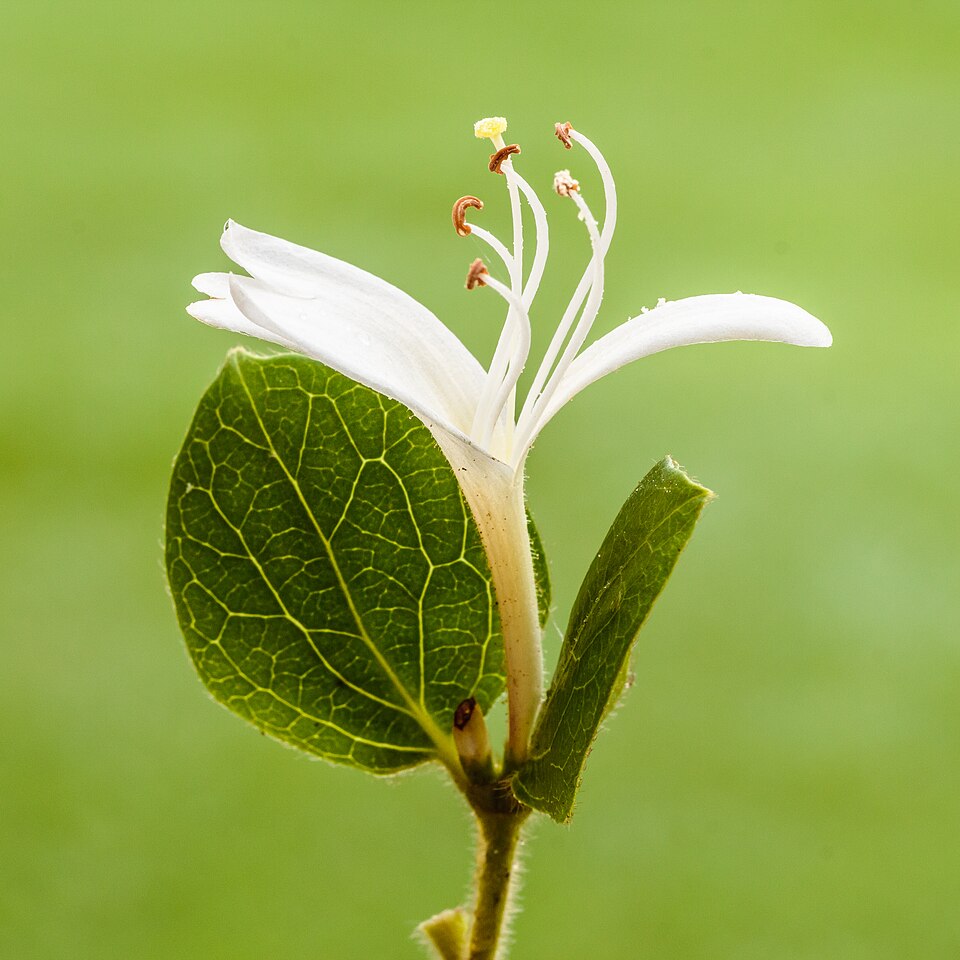

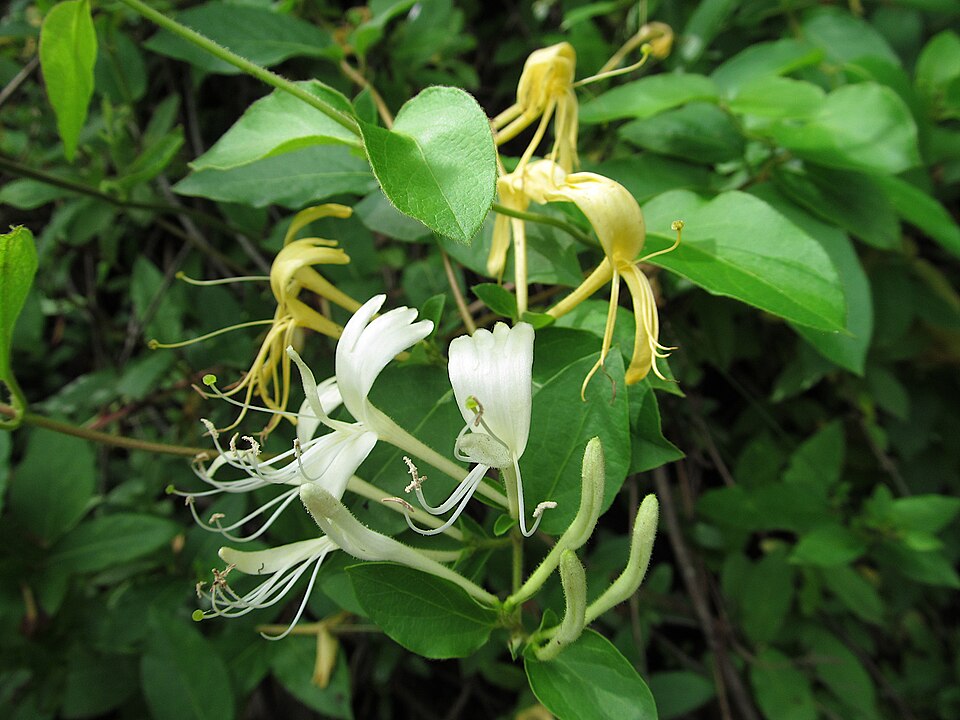

Why I take it out: it smells sweet, but it blankets the ground and climbs into the trees, and every place a runner touches down it roots again2. It takes steady pulling, but it does give up.
Quick facts
- Grows: Twines and trails up to 80 ft, over shrubs and up into trees, or as a mat on the ground2
- Spreads by: Mostly runners that root where they touch soil, plus some seed from birds2
- Blooms: Fragrant white flowers in pairs that fade to yellow, late spring through summer1
- Berries: Small berries turn blue-black in fall1
- Where: Woods edges, fence rows and roadsides, and right under the shade of the woods2
- Harm: Dense mats on the ground and tangles high in the trees crowd out native plants2
How to tell it apart
- Leaves: in pairs, oval, green much of the winter; young leaves can be lobed1 2.
- Stems: young stems are reddish and fuzzy; older stems are hollow, with bark peeling in strips1.
- Native look-alikes: native vine honeysuckles usually have reddish, hairless stems and hairless leaves, and don’t form big mats2.
Removal by season (how I do it)
- Late fall to early spring: pull runners and roots when the soil is moist, every rooted spot2 5.
- Any time: cut climbing vines at the base2.
- Growing season, every year: re-pull resprouts, and mow or string-trim open patches often, before the berries ripen, until the roots run out5.
- Last resort, only on a thick vine climbing a tree or fence: I cut it just above the ground and paint triclopyr on the cut stem at once, July to October6. I never spray it. Near water, I use only a product labeled for aquatic use7. The full steps are in my free checklist.
Plant this instead
Coral honeysuckle (Lonicera sempervirens) or crossvine (Bignonia capreolata). TN-IPC lists both as native swaps for Japanese honeysuckle8. Both are on record in Anderson, Knox and Roane counties9 10.
Myth: “It’s an old-timey Southern plant.” It’s been here a long time, but it came from Asia, and it still smothers native plants1 2.
If you’d like more East Tennessee plant notes, join our email list and get a free East Tennessee invasives checklist.
Sources
- NC State Extension Plant Toolbox: Lonicera japonica
- USDA Forest Service, Miller et al., SRS-131
- TN-IPC invasive plant list (CSV)
- TN-KY Plant Atlas
- UT Extension W1924-E, Bush Honeysuckle and Japanese Honeysuckle (Clatterbuck)
- TN-IPC, Japanese honeysuckle (invasive plant page)
- Wisconsin DNR, Triclopyr chemical fact sheet
- TN-IPC, Native Plant Alternatives (2016)
- TN-KY Plant Atlas: Lonicera sempervirens
- TN-KY Plant Atlas: Bignonia capreolata
Last checked Nov 26, 2026.