
Albizia julibrissin Durazz. · Pea family (Fabaceae) · Deciduous tree from Asia1
Invasive in Tennessee · TN-IPC: Established2 · Found in Anderson, Knox and Roane counties3
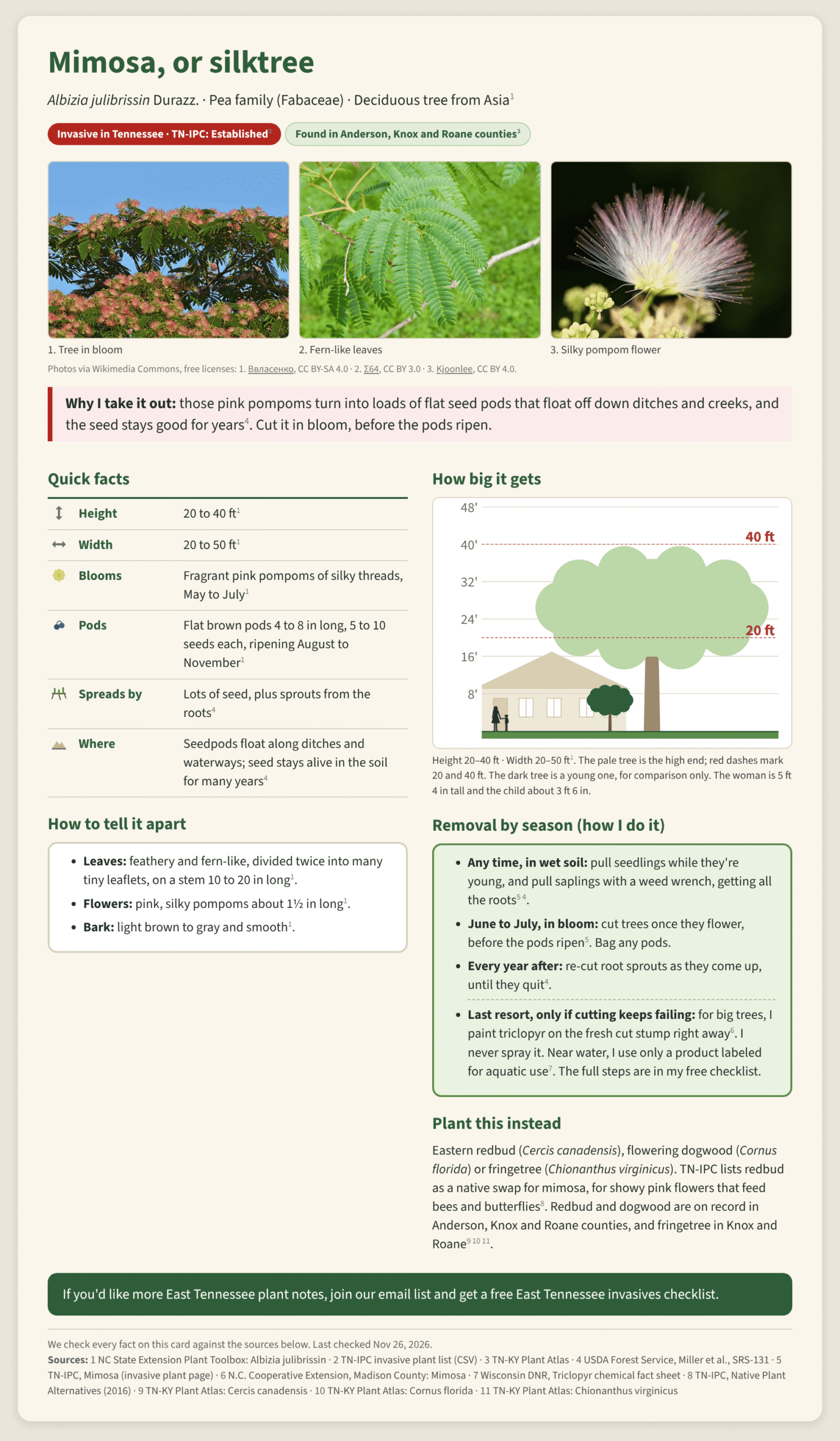



Why I take it out: those pink pompoms turn into loads of flat seed pods that float off down ditches and creeks, and the seed stays good for years4. Cut it in bloom, before the pods ripen.
Quick facts
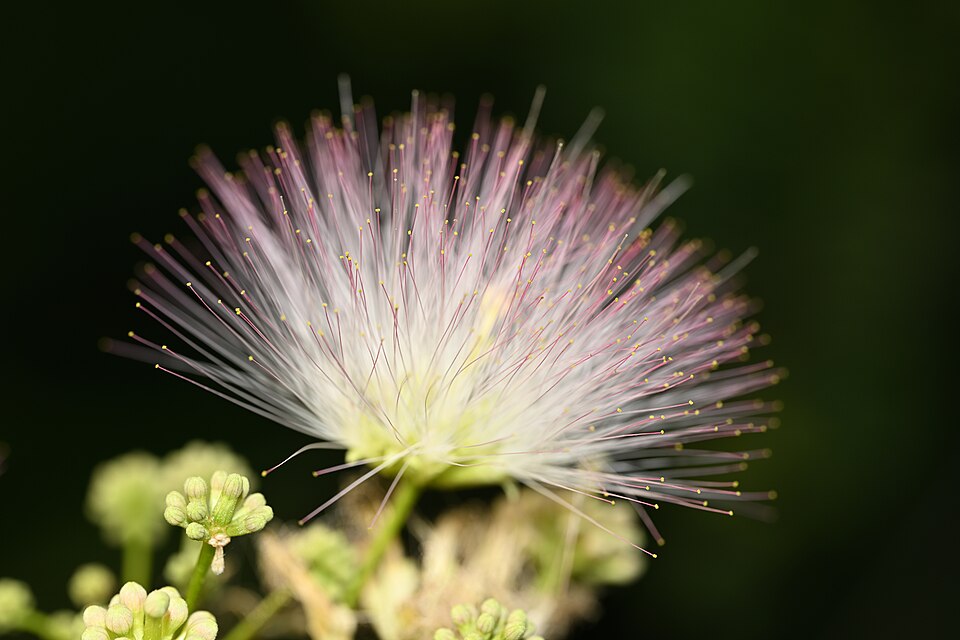
- Height: 20 to 40 ft1
- Width: 20 to 50 ft1
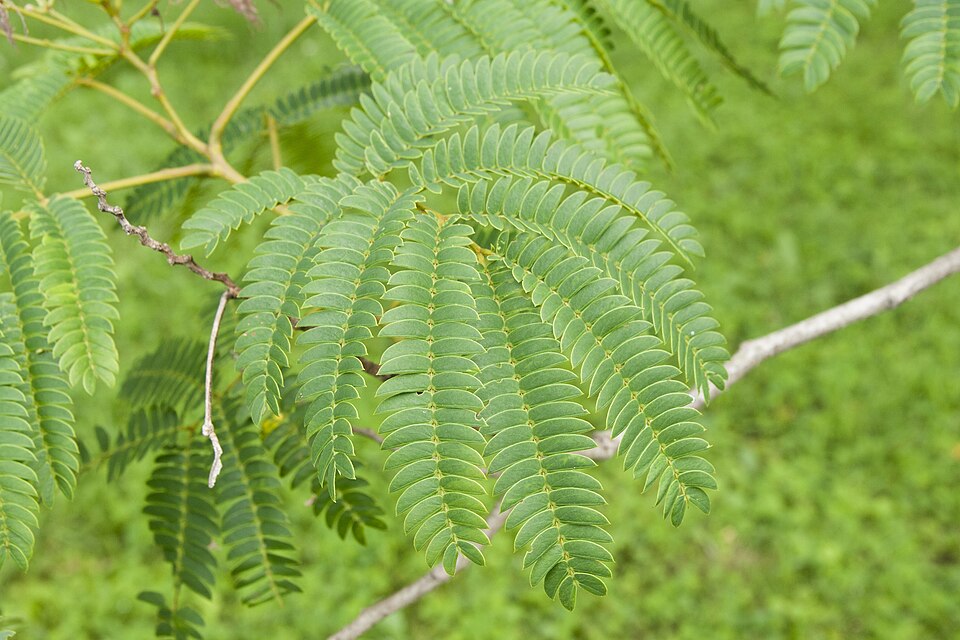
- Blooms: Fragrant pink pompoms of silky threads, May to July1
- Pods: Flat brown pods 4 to 8 in long, 5 to 10 seeds each, ripening August to November1
- Spreads by: Lots of seed, plus sprouts from the roots4
- Where: Seedpods float along ditches and waterways; seed stays alive in the soil for many years4
How to tell it apart
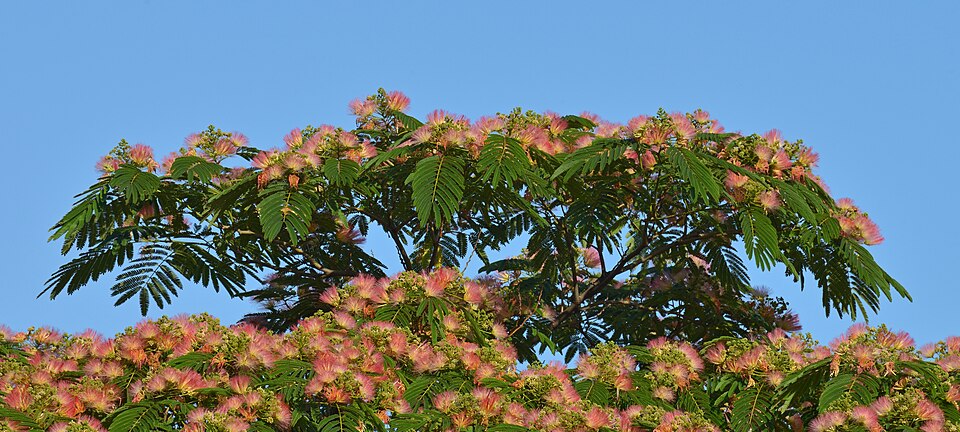
- Leaves: feathery and fern-like, divided twice into many tiny leaflets, on a stem 10 to 20 in long1.
- Flowers: pink, silky pompoms about 1½ in long1.
- Bark: light brown to gray and smooth1.
How big it gets
Height 20–40 ft · Width 20–50 ft1. The pale tree is the high end; red dashes mark 20 and 40 ft. The dark tree is a young one, for comparison only. The woman is 5 ft 4 in tall and the child about 3 ft 6 in.
Removal by season (how I do it)
- Any time, in wet soil: pull seedlings while they’re young, and pull saplings with a weed wrench, getting all the roots5 4.
- June to July, in bloom: cut trees once they flower, before the pods ripen5. Bag any pods.
- Every year after: re-cut root sprouts as they come up, until they quit4.
- Last resort, only if cutting keeps failing: for big trees, I paint triclopyr on the fresh cut stump right away6. I never spray it. Near water, I use only a product labeled for aquatic use7. The full steps are in my free checklist.
Plant this instead
Eastern redbud (Cercis canadensis), flowering dogwood (Cornus florida) or fringetree (Chionanthus virginicus). TN-IPC lists redbud as a native swap for mimosa, for showy pink flowers that feed bees and butterflies8. Redbud and dogwood are on record in Anderson, Knox and Roane counties, and fringetree in Knox and Roane9 10 11.
If you’d like more East Tennessee plant notes, join our email list and get a free East Tennessee invasives checklist.
Sources
- NC State Extension Plant Toolbox: Albizia julibrissin
- TN-IPC invasive plant list (CSV)
- TN-KY Plant Atlas
- USDA Forest Service, Miller et al., SRS-131
- TN-IPC, Mimosa (invasive plant page)
- N.C. Cooperative Extension, Madison County: Mimosa
- Wisconsin DNR, Triclopyr chemical fact sheet
- TN-IPC, Native Plant Alternatives (2016)
- TN-KY Plant Atlas: Cercis canadensis
- TN-KY Plant Atlas: Cornus florida
- TN-KY Plant Atlas: Chionanthus virginicus
Last checked Nov 26, 2026.