
Euonymus alatus (Thunb.) Siebold · Bittersweet family (Celastraceae) · Deciduous shrub from eastern Asia1
Invasive in Tennessee · TN-IPC: Established2 · Found in Anderson, Knox and Roane counties3
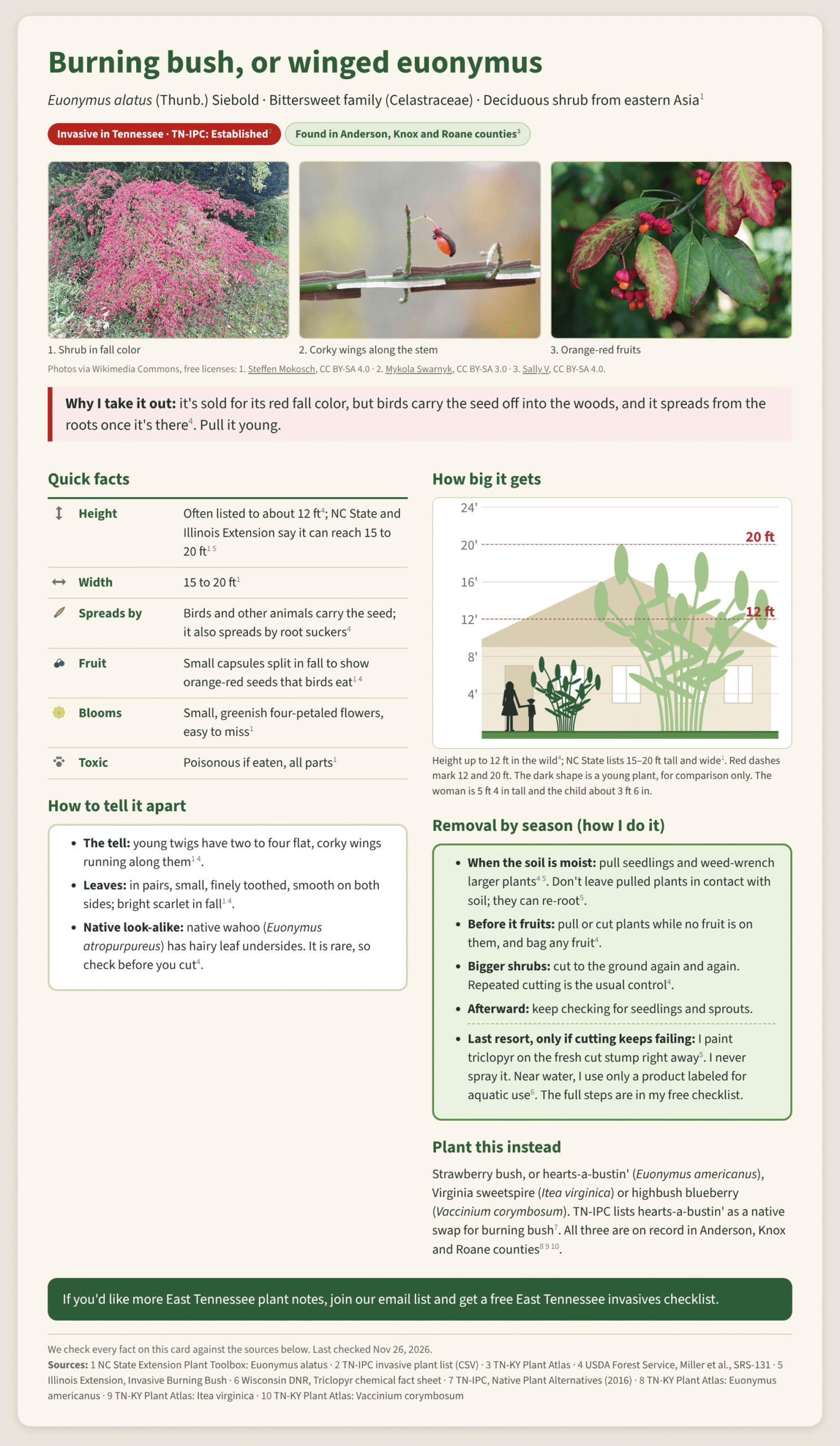



Why I take it out: it’s sold for its red fall color, but birds carry the seed off into the woods, and it spreads from the roots once it’s there4. Pull it young.
Quick facts
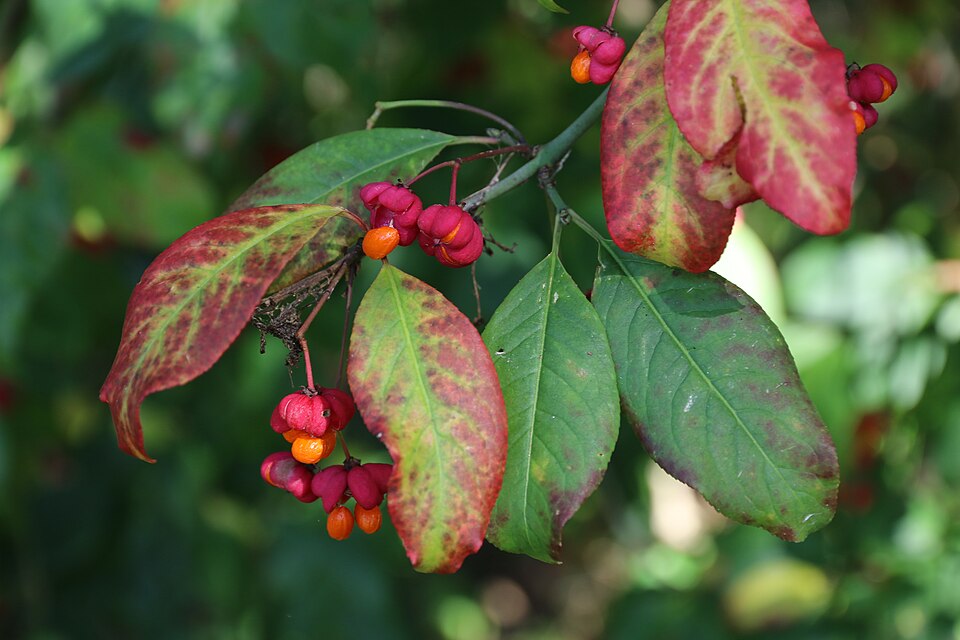
- Height: Often listed to about 12 ft4; NC State and Illinois Extension say it can reach 15 to 20 ft1 5
- Width: 15 to 20 ft1
- Spreads by: Birds and other animals carry the seed; it also spreads by root suckers4
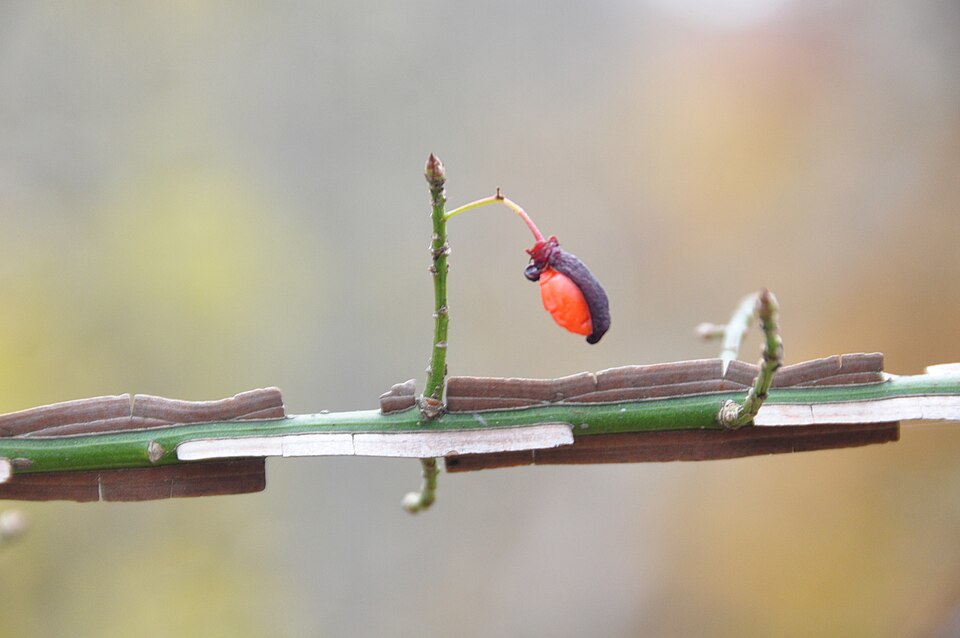
- Fruit: Small capsules split in fall to show orange-red seeds that birds eat1 4
- Blooms: Small, greenish four-petaled flowers, easy to miss1
- Toxic: Poisonous if eaten, all parts1
How to tell it apart
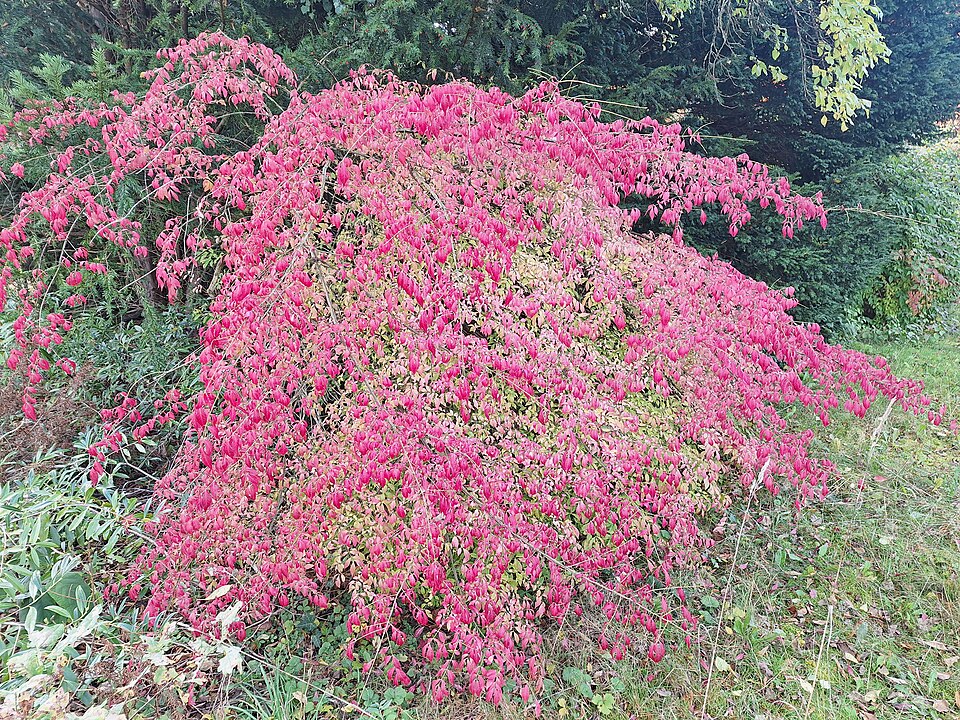
- The tell: young twigs have two to four flat, corky wings running along them1 4.
- Leaves: in pairs, small, finely toothed, smooth on both sides; bright scarlet in fall1 4.
- Native look-alike: native wahoo (Euonymus atropurpureus) has hairy leaf undersides. It is rare, so check before you cut4.
How big it gets
Height up to 12 ft in the wild4; NC State lists 15–20 ft tall and wide1. Red dashes mark 12 and 20 ft. The dark shape is a young plant, for comparison only. The woman is 5 ft 4 in tall and the child about 3 ft 6 in.
Removal by season (how I do it)
- When the soil is moist: pull seedlings and weed-wrench larger plants4 5. Don’t leave pulled plants in contact with soil; they can re-root5.
- Before it fruits: pull or cut plants while no fruit is on them, and bag any fruit4.
- Bigger shrubs: cut to the ground again and again. Repeated cutting is the usual control4.
- Afterward: keep checking for seedlings and sprouts.
- Last resort, only if cutting keeps failing: I paint triclopyr on the fresh cut stump right away5. I never spray it. Near water, I use only a product labeled for aquatic use6. The full steps are in my free checklist.
Plant this instead
Strawberry bush, or hearts-a-bustin’ (Euonymus americanus), Virginia sweetspire (Itea virginica) or highbush blueberry (Vaccinium corymbosum). TN-IPC lists hearts-a-bustin’ as a native swap for burning bush7. All three are on record in Anderson, Knox and Roane counties8 9 10.
If you’d like more East Tennessee plant notes, join our email list and get a free East Tennessee invasives checklist.
Sources
- NC State Extension Plant Toolbox: Euonymus alatus
- TN-IPC invasive plant list (CSV)
- TN-KY Plant Atlas
- USDA Forest Service, Miller et al., SRS-131
- Illinois Extension, Invasive Burning Bush
- Wisconsin DNR, Triclopyr chemical fact sheet
- TN-IPC, Native Plant Alternatives (2016)
- TN-KY Plant Atlas: Euonymus americanus
- TN-KY Plant Atlas: Itea virginica
- TN-KY Plant Atlas: Vaccinium corymbosum
Last checked Nov 26, 2026.