
Pyrus calleryana Decne. · Rose family (Rosaceae) · Deciduous tree from China, Vietnam and Japan1
Invasive in Tennessee · TN-IPC: Established2 · Found in Knox County3
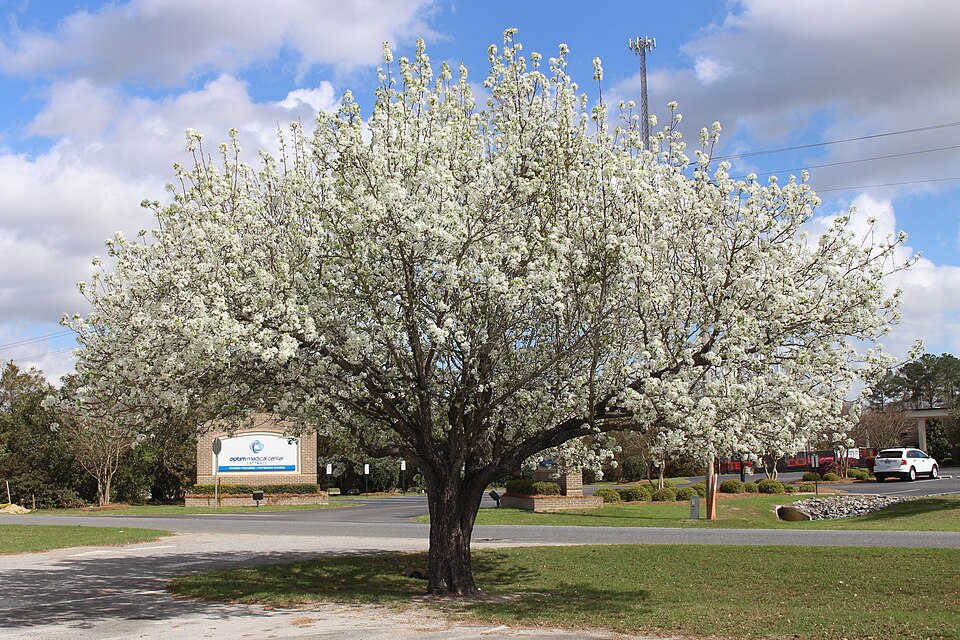



Why I take it out: those white trees along every highway in March are escaped pears. Different varieties cross-pollinate, birds spread the fruit, and the wild ones come up thorny and make thickets4. It’s a long job, so start with the small ones.
Quick facts
- Height: 30 to 50 ft1; up to 60 ft4
- Width: 20 to 35 ft1
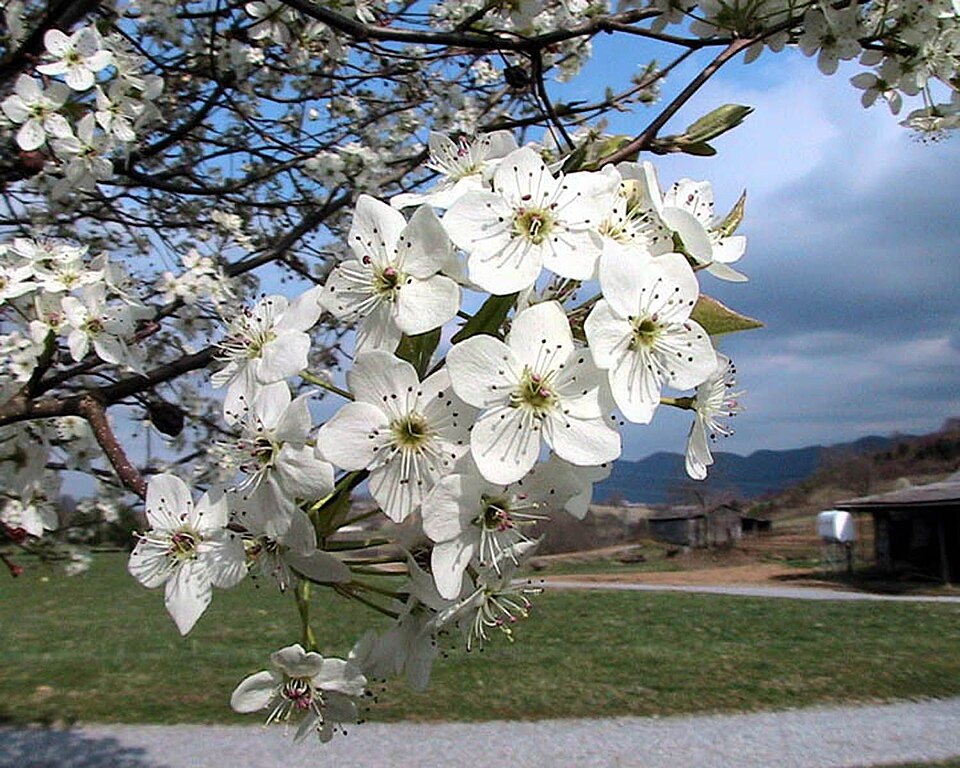
- Blooms: Dense clusters of white flowers in early spring, with an unpleasant smell1 4
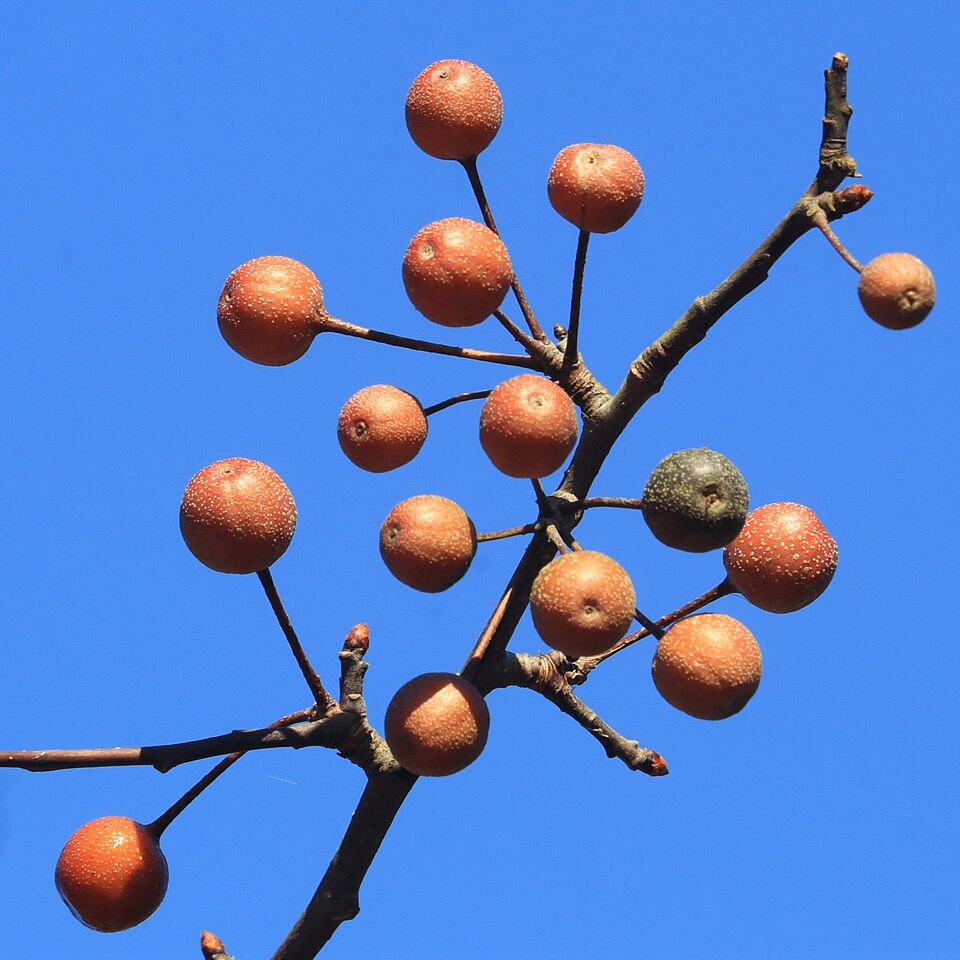
- Fruit: Small, hard pears, ½ to 1 in, that hang on through fall and winter; birds spread them1 4
- Spreads by: Seed, plus root sprouts that turn into thickets. Fruits from about 3 years old4
- Weak wood: Branches fork at narrow angles and often split in wind and ice storms4
- Handle with care: Escaped trees can be thorny; wear eye protection4
How to tell it apart
- Spring: a cloud of white bloom before most trees leaf out. Mark trees while they bloom1.
- Leaves: shiny, oval, with wavy, finely rounded edges on long stalks; red to purple in fall1 4.
- Twigs: stubby side branches, often tipped with a thorn on wild trees4 1.
- Bark: smooth and light brown when young, ridged and blocky with age1.
How big it gets
Height 30–50 ft · Width 20–35 ft1. The pale tree is the high end; red dashes mark 30 and 50 ft. The dark tree is a young one, for comparison only. The woman is 5 ft 4 in tall and the child about 3 ft 6 in.
Removal by season (how I do it)
- When the soil is moist: pull seedlings and weed-wrench saplings, getting all the roots. Root pieces left behind sprout4 5.
- Big trees: cut them down and either grind the stump or, as a last resort, paint the fresh cut (see below)6 7. Grinding is TN-IPC’s alternative to treating the stump.
- For several years: pull or re-cut every root sprout. UT Extension says roots left alive keep sprouting, so expect a long job7.
- Fall and winter: bag any fruit you can reach4.
- Last resort, only for a big tree whose stump I can’t grind: I paint triclopyr on the fresh cut stump as soon as it’s cut7. I never spray it. Near water, I use only a product labeled for aquatic use8. The full steps are in my free checklist.
Plant this instead
Downy serviceberry (Amelanchier arborea), fringetree (Chionanthus virginicus) or eastern redbud (Cercis canadensis). TN-IPC lists serviceberry as a native swap for Callery pear9. Serviceberry and redbud are on record in Anderson, Knox and Roane counties, and fringetree in Knox and Roane10 11 12.
Myth: “Bradford pears can’t make seed.” One variety alone may not, but different Callery varieties cross-pollinate and make fertile seed4.
If you’d like more East Tennessee plant notes, join our email list and get a free East Tennessee invasives checklist.
Sources
- NC State Extension Plant Toolbox: Pyrus calleryana
- TN-IPC invasive plant list (CSV)
- TN-KY Plant Atlas: Pyrus calleryana
- USDA Forest Service, Miller et al., SRS-131
- Penn State Extension, Callery Pear
- TN-IPC, Callery pear (invasive plant page)
- UT Extension W1924-G, Callery Pear (Clatterbuck)
- Wisconsin DNR, Triclopyr chemical fact sheet
- TN-IPC, Native Plant Alternatives (2016)
- TN-KY Plant Atlas: Amelanchier arborea
- TN-KY Plant Atlas: Cercis canadensis
- TN-KY Plant Atlas: Chionanthus virginicus
Last checked Nov 26, 2026.