
Vinca minor L. · Dogbane family (Apocynaceae) · Evergreen groundcover from Europe1
Invasive in Tennessee · TN-IPC: Established2 · Found in Anderson, Knox and Roane counties3
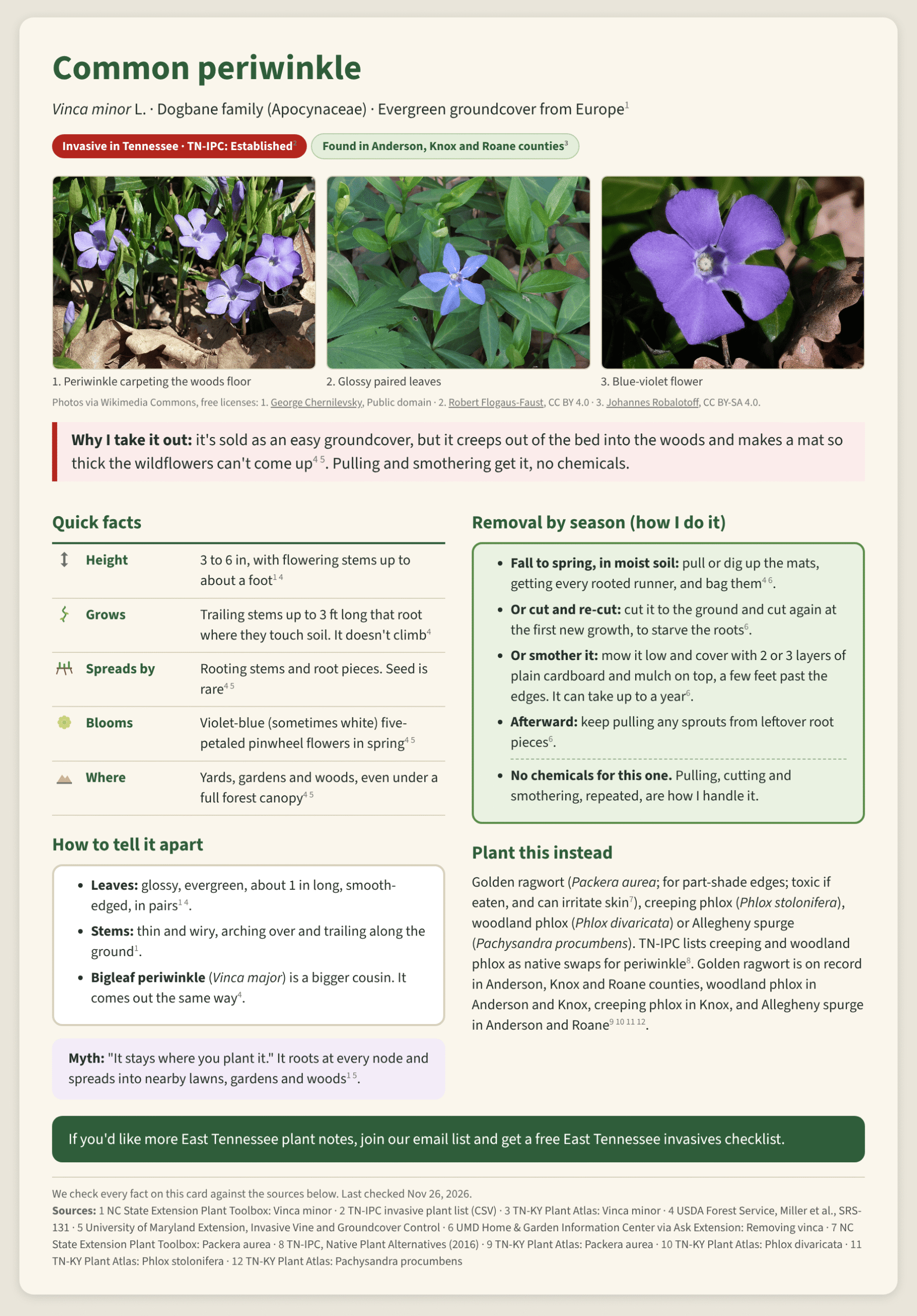



Why I take it out: it’s sold as an easy groundcover, but it creeps out of the bed into the woods and makes a mat so thick the wildflowers can’t come up4 5. Pulling and smothering get it, no chemicals.
Quick facts
- Height: 3 to 6 in, with flowering stems up to about a foot1 4
- Grows: Trailing stems up to 3 ft long that root where they touch soil. It doesn’t climb4
- Spreads by: Rooting stems and root pieces. Seed is rare4 5
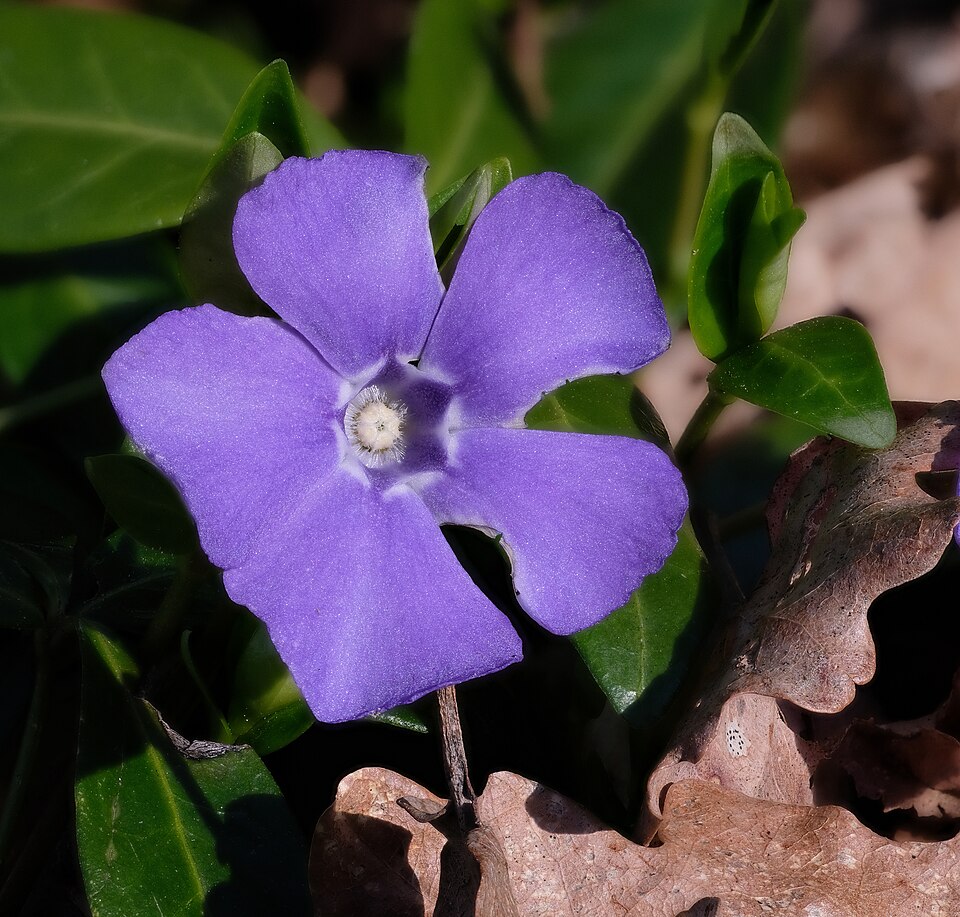
- Blooms: Violet-blue (sometimes white) five-petaled pinwheel flowers in spring4 5
- Where: Yards, gardens and woods, even under a full forest canopy4 5
How to tell it apart
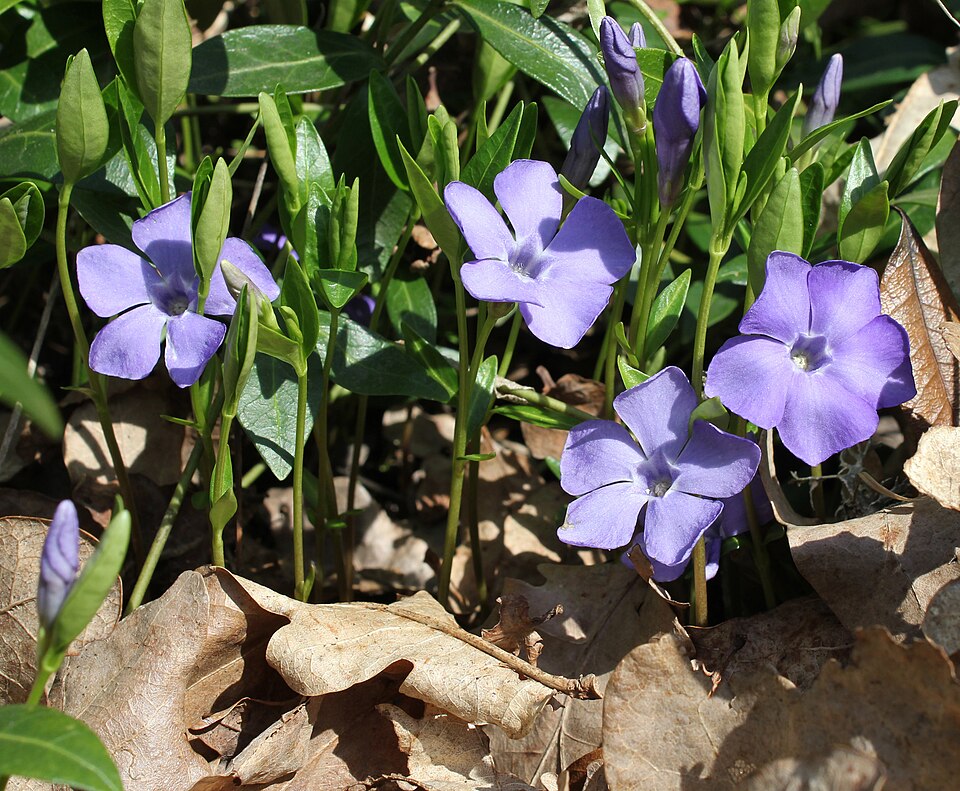
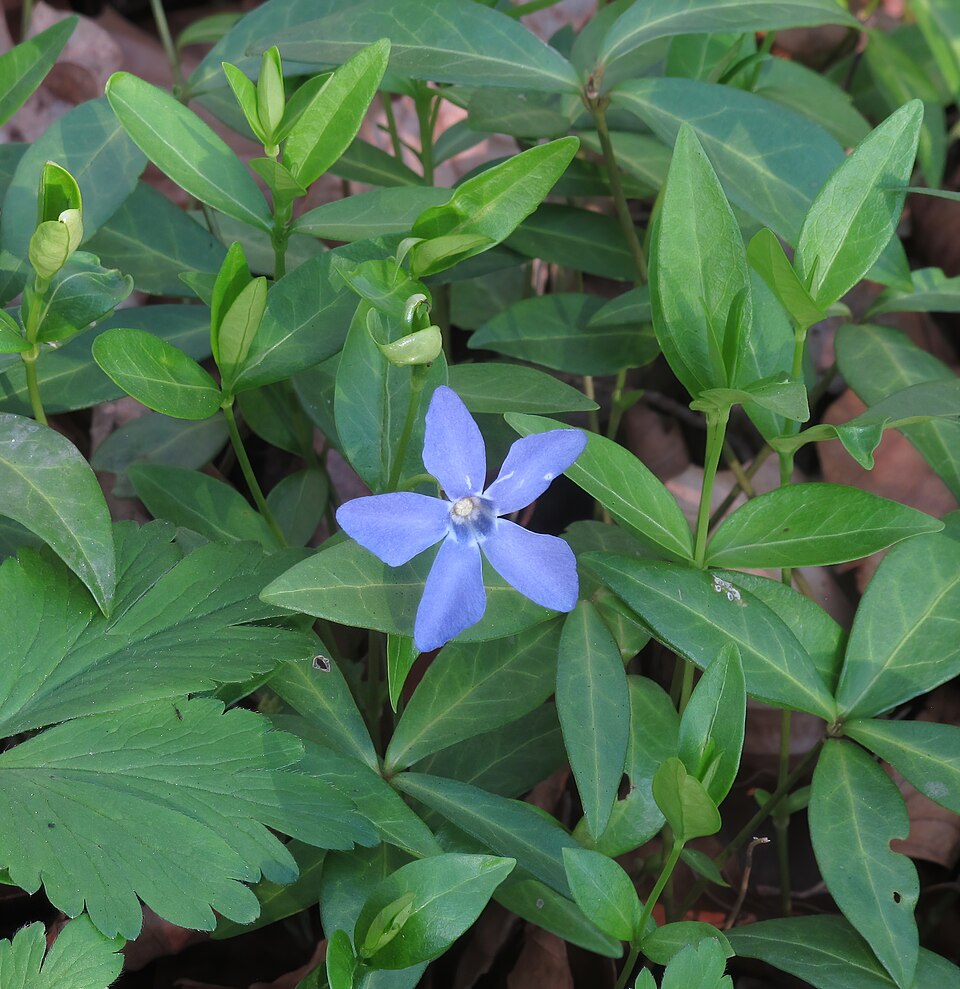
- Leaves: glossy, evergreen, about 1 in long, smooth-edged, in pairs1 4.
- Stems: thin and wiry, arching over and trailing along the ground1.
- Bigleaf periwinkle (Vinca major) is a bigger cousin. It comes out the same way4.
Removal by season (how I do it)
- Fall to spring, in moist soil: pull or dig up the mats, getting every rooted runner, and bag them4 6.
- Or cut and re-cut: cut it to the ground and cut again at the first new growth, to starve the roots6.
- Or smother it: mow it low and cover with 2 or 3 layers of plain cardboard and mulch on top, a few feet past the edges. It can take up to a year6.
- Afterward: keep pulling any sprouts from leftover root pieces6.
- No chemicals for this one. Pulling, cutting and smothering, repeated, are how I handle it.
Plant this instead
Golden ragwort (Packera aurea; for part-shade edges; toxic if eaten, and can irritate skin7), creeping phlox (Phlox stolonifera), woodland phlox (Phlox divaricata) or Allegheny spurge (Pachysandra procumbens). TN-IPC lists creeping and woodland phlox as native swaps for periwinkle8. Golden ragwort is on record in Anderson, Knox and Roane counties, woodland phlox in Anderson and Knox, creeping phlox in Knox, and Allegheny spurge in Anderson and Roane9 10 11 12.
Myth: “It stays where you plant it.” It roots at every node and spreads into nearby lawns, gardens and woods1 5.
If you’d like more East Tennessee plant notes, join our email list and get a free East Tennessee invasives checklist.
Sources
- NC State Extension Plant Toolbox: Vinca minor
- TN-IPC invasive plant list (CSV)
- TN-KY Plant Atlas: Vinca minor
- USDA Forest Service, Miller et al., SRS-131
- University of Maryland Extension, Invasive Vine and Groundcover Control
- UMD Home & Garden Information Center via Ask Extension: Removing vinca
- NC State Extension Plant Toolbox: Packera aurea
- TN-IPC, Native Plant Alternatives (2016)
- TN-KY Plant Atlas: Packera aurea
- TN-KY Plant Atlas: Phlox divaricata
- TN-KY Plant Atlas: Phlox stolonifera
- TN-KY Plant Atlas: Pachysandra procumbens
Last checked Nov 26, 2026.