
Ailanthus altissima (Mill.) Swingle · Quassia family (Simaroubaceae) · Deciduous tree from China1 2
Invasive in Tennessee · TN-IPC: Established3 · Found in Anderson, Knox and Roane counties4 · A preferred host of spotted lanternfly5
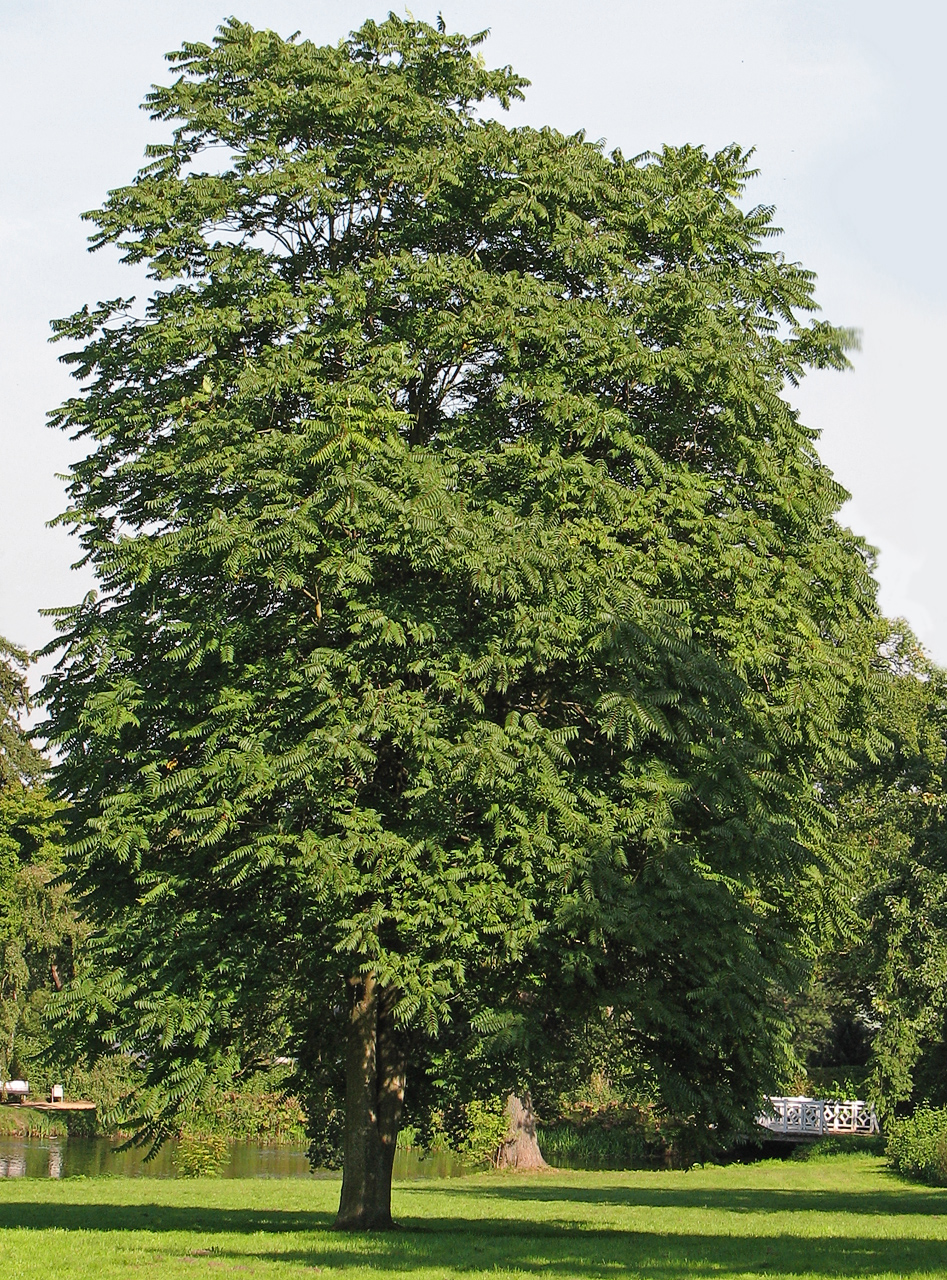



Why I take it out: it outgrows almost everything around it, it spreads by seed and by roots, and it’s a preferred host of spotted lanternfly6 5. A seedling pulls in seconds. A grown tree takes years.
Quick facts
- Height: 40 to 60 ft2; can top 80 ft6
- Width: 15 to 30 ft2
- Growth: Very fast. Seedlings grow 3 to 6 ft a year; root sprouts 8 to 10 ft the first year6
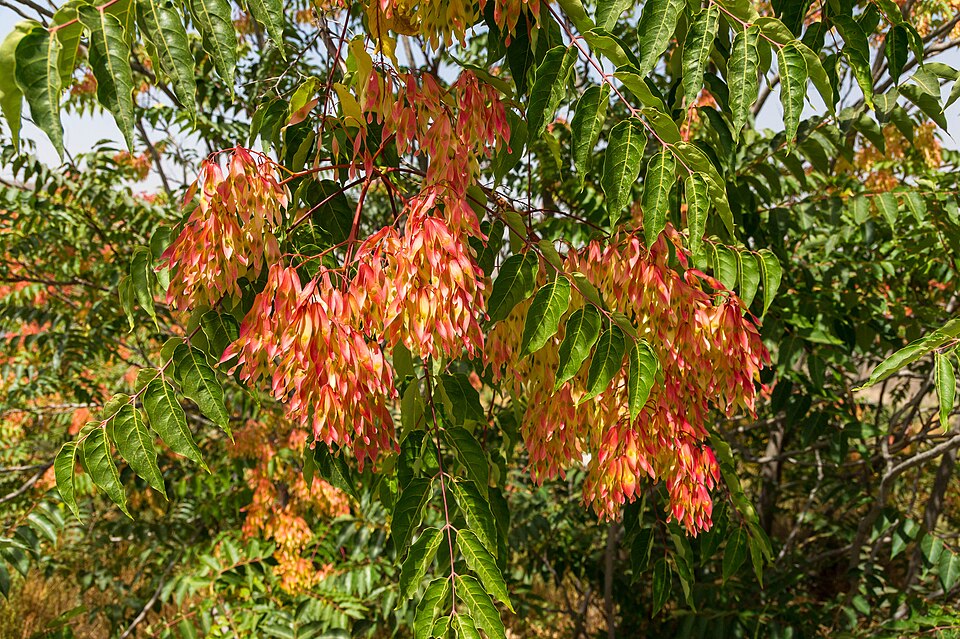
- Seeds: A female tree can drop more than 300,000 winged seeds a year, and wind carries them up to 300 ft6
- Root sprouts: Come up 30 to 50 ft from the nearest trunk6
- Where: Anywhere the soil gets bared or disturbed: road banks, edges, fence rows6
- Blooms: Big yellow-green clusters, May to June; they can smell bad2
- Soil: Puts out chemicals that hold back other plants (allelopathy)6 2
- Handle with care: Sap can irritate skin. Wear gloves and long sleeves7
How to tell it apart
- Leaf: one leaf is 1 to 4 ft long with 10 to 40 leaflets, alternate on the twig7 2.
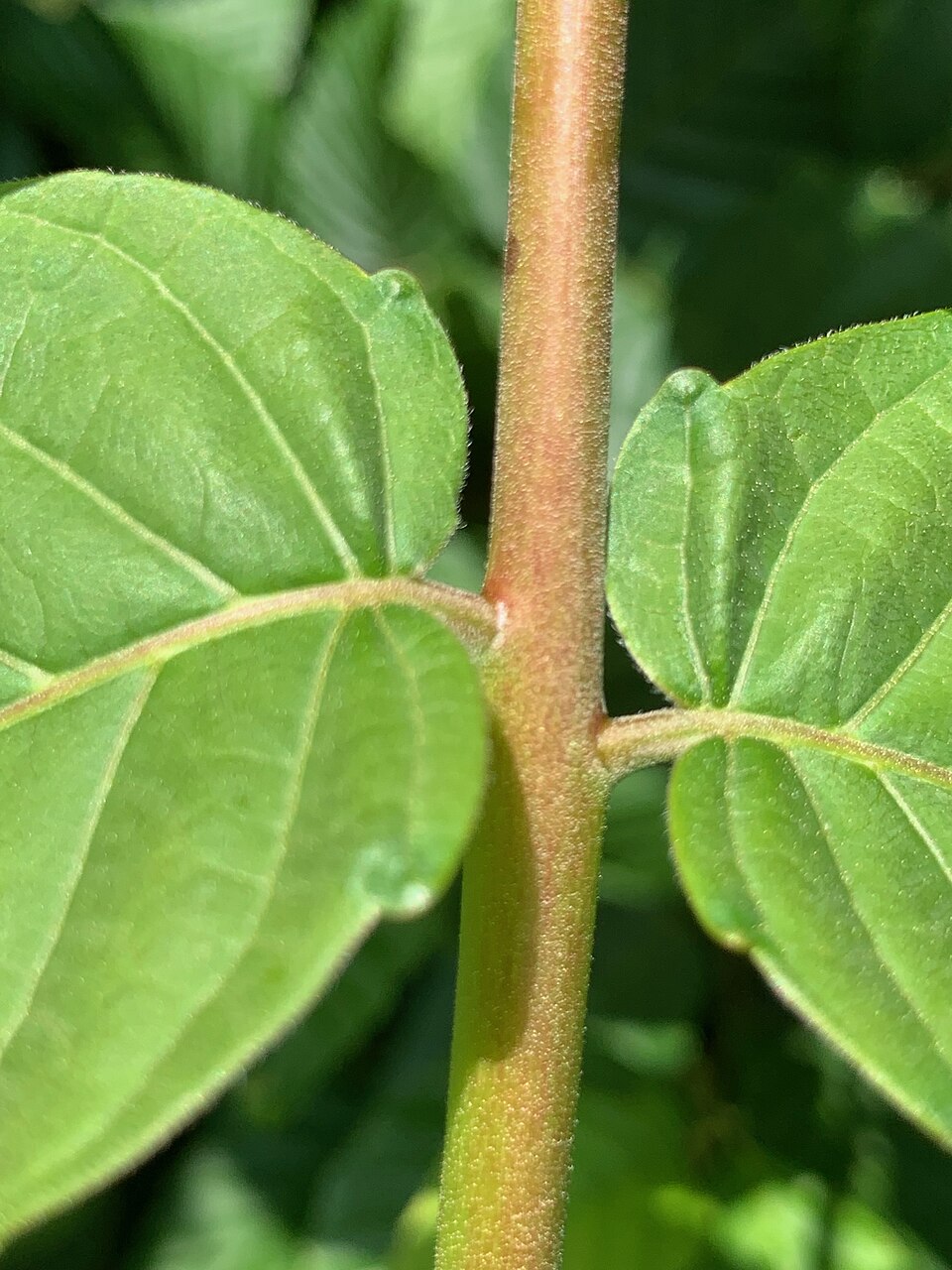
- The tell: each leaflet has one or two glandular teeth near the base, with a gland on the underside of each tooth. The rest of the leaflet edge is smooth7 6 8.
- Smell: crush a leaf or snap a twig. It smells foul, like rancid peanut butter7 6.
- Bark: smooth and pale gray, later like the skin of a cantaloupe7.
- Native look-alikes: don’t go by toothed edges alone. Winged sumac has smooth leaflet edges too, but its leaf stem has little wings between the leaflets, and it has no glands at the base9. Smooth and staghorn sumac, black walnut and hickories have toothed leaflet edges and no basal glands7. Crushed black walnut leaves smell spicy or citrusy, not foul10 11. Please leave the natives standing.
How big it gets
Height 40–60 ft · Width 15–30 ft2. The pale tree is the high end; red dashes mark 40 and 60 ft. The dark tree is a root sprout after one year, about 10 ft6. The woman is 5 ft 4 in tall and the child about 3 ft 6 in.
Removal by season (how I do it)
- Spring to fall, when the soil is moist: pull seedlings, roots and all. Bits of root left behind sprout again. A sprout coming off a root, not from a seed, is nearly impossible to pull7.
- Don’t just cut down a big tree. Cutting or girdling alone brings dozens of stump and root sprouts6 7 8. Painting the cut stump won’t stop the root suckers. Treat the standing tree first, and cut only after it’s dead7.
- Every year after: watch for new sprouts and for seedlings from seed in the soil. Getting it all takes repeat work and patience6.
- Late fall through winter: check trunks for spotted lanternfly egg masses, which look like spattered mud, and report them to the TN Department of Agriculture5.
- Last resort, big trees only: if pulling and cutting haven’t worked, I put triclopyr into spaced cuts in the standing trunk (hack-and-squirt), midsummer to midwinter, never in spring when the sap is rising6 8. I never spray it. Near water, I use only a product labeled for aquatic use12. If the tree has to come down, I treat it first and cut it once it’s dead7. The full steps are in my free checklist.
Plant this instead
Smooth sumac (Rhus glabra), winged sumac (Rhus copallinum) or hoptree (Ptelea trifoliata). All three are East Tennessee natives that TN-IPC lists in place of tree-of-heaven13. Both sumacs are on record in Anderson, Knox and Roane counties, and hoptree in Knox and Roane14 15 16. Sumac grows fast and gives you fall color and fruit clusters for birds and bees; hoptree’s seed clusters feed birds and butterflies13. Plant right away. Bare ground is just what tree-of-heaven is waiting for6.
Myth: “Just cut it down.” Cutting is how one tree turns into a thicket. The roots have to die before the tree is beat6 7.
If you’d like more East Tennessee plant notes, join our email list and get a free East Tennessee invasives checklist.
Sources
- USDA PLANTS: Ailanthus altissima
- NC State Extension Plant Toolbox: Ailanthus altissima
- TN-IPC invasive plant list (CSV)
- TN-KY Plant Atlas: Ailanthus altissima
- TN Dept. of Agriculture, Spotted Lanternfly
- UT Extension W1924-J, Tree-of-Heaven (Clatterbuck)
- Penn State Extension, Tree-of-Heaven
- USDA Forest Service, Miller et al., SRS-131
- NC State Extension Plant Toolbox: Rhus copallinum
- Virginia Cooperative Extension, Invasive Plant Species: Ailanthus (SPES-775NP)
- Missouri Dept. of Conservation, Black Walnut
- Wisconsin DNR, Triclopyr chemical fact sheet
- TN-IPC, Native Plant Alternatives (2016)
- TN-KY Plant Atlas: Rhus glabra
- TN-KY Plant Atlas: Rhus copallinum
- TN-KY Plant Atlas: Ptelea trifoliata
Last checked Nov 26, 2026.